The Phenomenon of Murti: How the Infinite Fits into Finite Form
To the untrained outsider, the vibrant rituals surrounding Hindu deities often look like simplistic idolatry—the literal worship of stone, wood, or metal. Yet, within the sophisticated metaphysics of Sanatana Dharma, these physical forms are known as Murti, meaning "manifestation" or "embodiment." Far from a primitive superstition, the use of Murtis is a highly conscious, intellectually rigorous concession to the limitations of human psychology. It is the bridge built between the finite capacity of the human brain and the infinite nature of the Absolute.
The human intellect is fundamentally incapable of directly contemplating a pure abstraction. We cannot love a mathematical equation, nor can we emotionally commune with a vast, featureless void. The supreme reality, Brahman, is described as Nirguna—attribute-less, formless, beyond space, and outside of time.
Trying to force the human mind to meditate on the formless Absolute is like asking a bird to fly in a vacuum; there is nothing for the wings of thought to grip. The mind naturally wanders, grows exhausted, and collapses back into its habitual patterns. Recognizing this psychological truth, ancient seers did not demand that humanity look directly into a blinding, invisible sun; instead, they provided a focal point.
A Murti functions precisely as a spiritual lens—a metaphysical magnifying glass. Just as the sun's rays are scattered everywhere across the earth but can only ignite a fire when concentrated through a glass lens, the divine presence is omnipresent but remains diffuse to our ordinary senses.
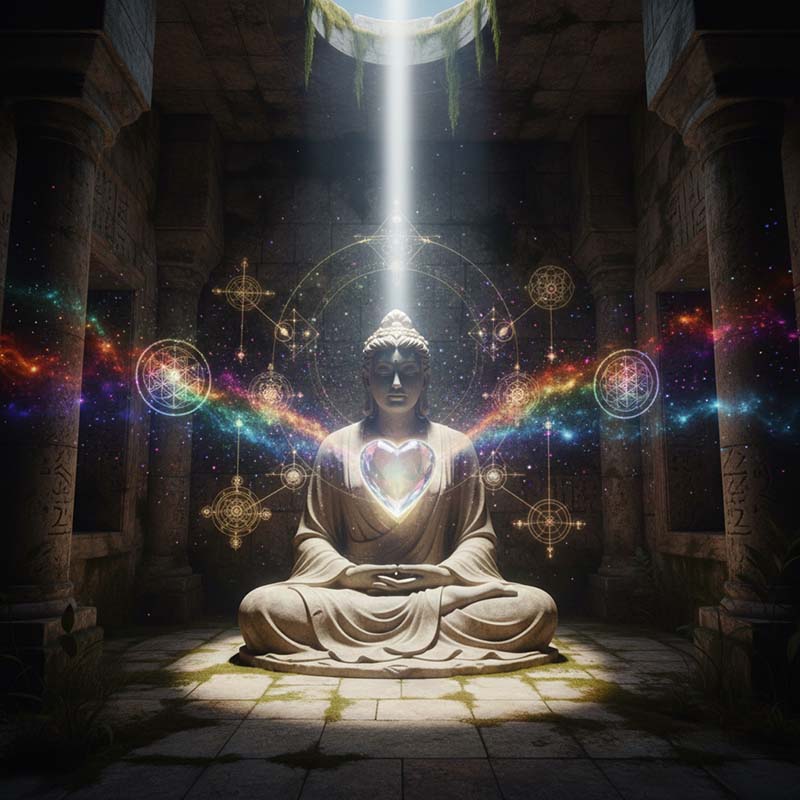
The sacred geometry, specific postures (mudras), and symbolic attributes of a Murti serve to capture, gather, and focus these scattered rays of divine reality. When a seeker gazes upon the form of a deity, their chaotic thoughts are unified into a single, structured point of concentration (ekagrata). The physical form becomes a doorway: you look at the stone, but you step through it into the infinite.
Therefore, a critical distinction must be made between worshiping a physical object and worshiping a cosmic principle through that object. No enlightened Hindu sage believes that God is literally trapped inside a specific block of marble or bronze. The ritual of Prana Pratishta (consecration) is not an act of creating God, but an act of inviting the supreme consciousness to localize its presence within a tangible vehicle for the benefit of the seeker.
The statue is a symbol, a concrete language for the soul. The four arms of a deity, the weapons they hold, the vehicles they ride—these are not anatomical anomalies, but a precise ideological alphabet representing cosmic laws, psychological forces, and metaphysical truths.
When the ritual is complete and the seeker looks upon the Murti, the stone effectively dissolves. What remains is a profound mirror reflecting back the ultimate truth: that the beauty, power, and divinity witnessed in the outer form is, in reality, the very nature of the Self (Atman) dwelling within.